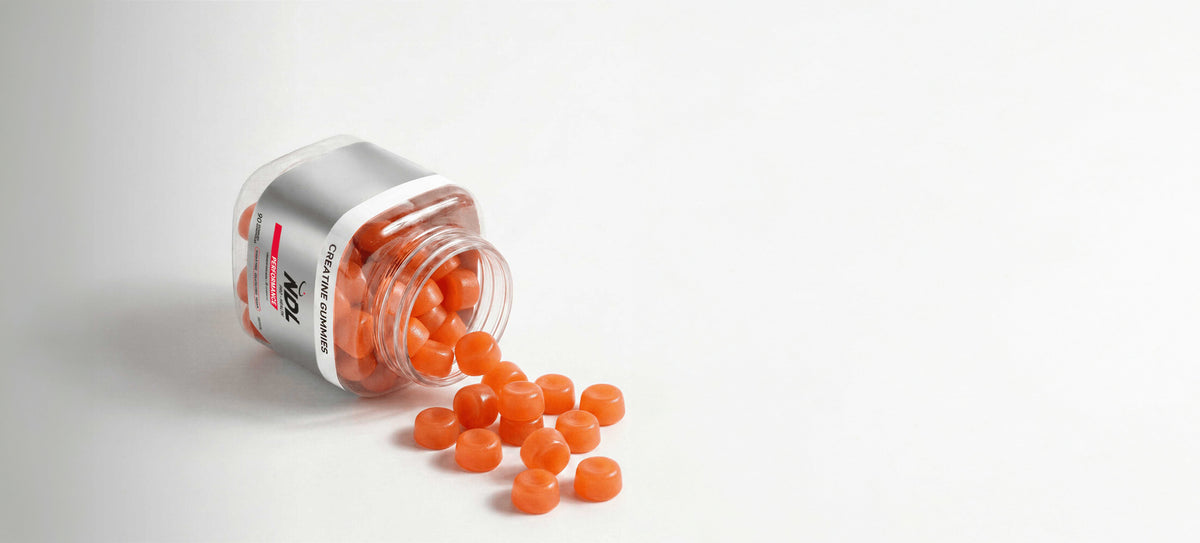
Creatine gummies have become one of the most convenient ways to supplement with creatine monohydrate. However, as they differ from the traditional powdered format, it is common for questions to arise about their composition and their impact on nutrition. One of the most frequent concerns is whether creatine gummies contain sugar.
Most of these questions are not related to creatine itself, but rather to the ingredients used in the formulation. Choosing high-quality gummies with an appropriate formulation and the correct dose of creatine monohydrate allows you to enjoy a convenient format without compromising the effectiveness of supplementation.
In this article, we answer the most common questions about creatine gummies, analyse their nutritional composition, and explain what scientific evidence says about their impact on intermittent fasting, the digestion of creatine gummies, and weight management diets, so you can confidently incorporate them into your daily routine.
Calorie Content and Sugar/Sweetener Profile of Functional Gummies
One of the most common questions is whether gummies are high in calories or sugar. The answer depends on the product's formulation, as not all creatine gummies are made the same.
While some products contain added sugars to improve flavour and texture, others are formulated without added sugar, using sweeteners that provide a pleasant taste while keeping the calorie content low. For this reason, it is always important to check both the nutrition facts and the ingredient list before making your choice.
In the case of NDL Pro-Health Creatine Gummies, they are formulated without added sugar and use a combination of sweeteners, including maltitol syrup, maltitol, isomalt, and sucralose, to deliver a pleasant taste. This makes them an easy and convenient option to enjoy while maintaining a low calorie intake as part of a balanced diet.

From a nutritional perspective, a serving of creatine gummies generally provides very few calories, making it an insignificant source of energy for most people. As a result, they can easily be incorporated into a balanced diet, whether your goal is to improve sports performance or manage body weight.
In other words, the gummy format does not necessarily mean a high sugar or calorie content. The key is choosing products formulated with high-quality ingredients and always checking their nutritional information.
Why Can Creatine Gummies Be Easier on Sensitive Stomachs?
Creatine monohydrate is a well-researched supplement with an excellent safety and tolerability profile for most people. However, consuming large amounts at once may occasionally cause mild digestive discomfort.
Creatine gummies can be a more comfortable option for people with sensitive stomachs, not because the creatine itself is different, but because of the way it is consumed. Since each serving is pre-measured and ready to eat, there is no risk of accidentally taking an excessively large dose or consuming undissolved powder.
In addition, because they are chewable, gummies are often easier to incorporate into everyday habits. Many people consume them alongside a meal or snack, which may also contribute to improved digestive comfort.
Ultimately, although creatine itself offers similar digestive tolerance regardless of its format, creatine gummies can provide a more enjoyable and convenient supplementation experience, especially for those who want to avoid the gritty texture of powder or are looking for a simpler way to include creatine in their daily routine.
Do Creatine Gummies Interfere with Intermittent Fasting or Cutting Diets?
The answer depends on your fasting goals and the formulation of the gummies. While creatine monohydrate itself provides virtually no calories and does not break a fast, gummies contain additional ingredients, such as sweeteners and gelling agents, which contribute a small amount of energy. For this reason, it is always important to check the calorie content of creatine gummies.
In the case of NDL Pro-Health Creatine Gummies, they are formulated without added sugar, but they do contain ingredients required to provide their texture and flavour. Therefore, if you are following a strict fasting protocol, the best option is to consume the gummies once your fasting window has ended.
When it comes to cutting or fat-loss diets, creatine gummies can easily be included as part of your nutrition plan. Their calorie content is low, and they contain no added sugar, meaning they have little impact on your overall daily calorie intake. In addition, creatine does not promote body fat gain and can be especially beneficial during this phase, as it helps maintain training performance while supporting muscle strength and lean muscle mass during periods of calorie restriction.
As a result, creatine gummies can be incorporated into both cutting diets and intermittent fasting strategies. However, if your goal is to maintain a strict fast, it is advisable to consume them during your eating window.
The Importance of Creatine Monohydrate for Muscle Health and Energy Production
Creatine monohydrate is one of the most extensively researched dietary supplements in sports nutrition. Although it is best known for enhancing physical performance, its primary role is to support the body's energy production systems during high-intensity exercise.
Within the body, creatine is stored mainly in the muscles as phosphocreatine, a compound that helps regenerate ATP (adenosine triphosphate), the body's main source of cellular energy. This process enables muscles to sustain higher levels of performance during activities such as strength training, sprinting, and other short-duration, high-intensity exercises.
Over time, maintaining optimal creatine stores may also contribute to preserving normal muscle function, particularly when combined with regular physical activity and a balanced diet. In fact, the European Food Safety Authority (EFSA) has authorised the health claim stating that a daily intake of 3 g of creatine enhances physical performance during successive bursts of short-term, high-intensity exercise. It has also authorised the claim that a daily intake of 3 g of creatine may enhance the effect of resistance training on muscle strength in adults over the age of 55 who engage in regular physical exercise.
Creatine can be obtained naturally from foods such as meat and fish. However, reaching the evidence-based intake of 3 g per day through diet alone can be difficult, especially for people who consume little or no animal-based foods. In these cases, creatine monohydrate supplementation provides a simple and reliable way to achieve the recommended daily intake.
In summary, creatine monohydrate plays a fundamental role in muscle energy metabolism and is an effective nutritional tool for supporting physical performance and muscle function when consumed daily at the recommended dose as part of an active lifestyle.