If you are looking to increase your muscle mass, improve post-workout recovery or simply ensure adequate protein intake, you have probably wondered which type of plant-based protein is best.
For years, plant-based proteins have been combined to complement their amino acid profiles. However, advances in the quality and processing of plant-based isolates have made it possible to develop alternatives with a high protein concentration from a single source, such as pea protein isolate.
But what are the real differences between these two options? Does a blend of plant-based proteins offer more benefits for your muscles? Or is choosing a high-quality pea protein isolate enough?
The answer does not depend solely on the protein source, but also on its essential amino acid profile, digestibility, the amount consumed and the quality of the formulation.
In this article, we explain the differences between pea protein and plant-based protein blends to help you understand which aspects to consider when choosing a protein that suits your muscle-building goals.
The Problem with Low-Cost Plant-Based Protein Blends
Plant-based proteins have become an increasingly popular alternative for those looking to support their muscles and supplement their diet. However, not all formulas offer the same nutritional quality or protein concentration.
Many vegan proteins combine different plant-based sources to achieve a more complete amino acid profile. Although this strategy can be beneficial, combining more ingredients does not necessarily mean obtaining a higher-quality protein.
The difference lies in the selection of raw materials, their degree of processing and the proportion of protein that each ingredient actually provides.
Therefore, when choosing the best plant-based protein, it is important to look beyond the number of ingredients and analyse what each serving actually provides.
Why Too Many Ingredients Dilute the Actual Protein Concentration
When you buy a plant-based protein supplement, you want to obtain an adequate amount of protein to contribute to the growth and maintenance of muscle mass. However, not every gram of product is equivalent to a gram of protein.
Some formulas combine different plant-based concentrates with additional ingredients such as fibres, thickeners, flavourings or carbohydrates. Although these components may serve specific purposes, they also make up part of the product's total composition.
This means that two supplements with a 30-gram serving can provide different amounts of protein, depending on their formulation.
It is also important to distinguish between a plant-based concentrate and a high-quality protein isolate. Isolates undergo more extensive filtration, which increases the percentage of pure protein and minimises the remaining components of the original ingredient.
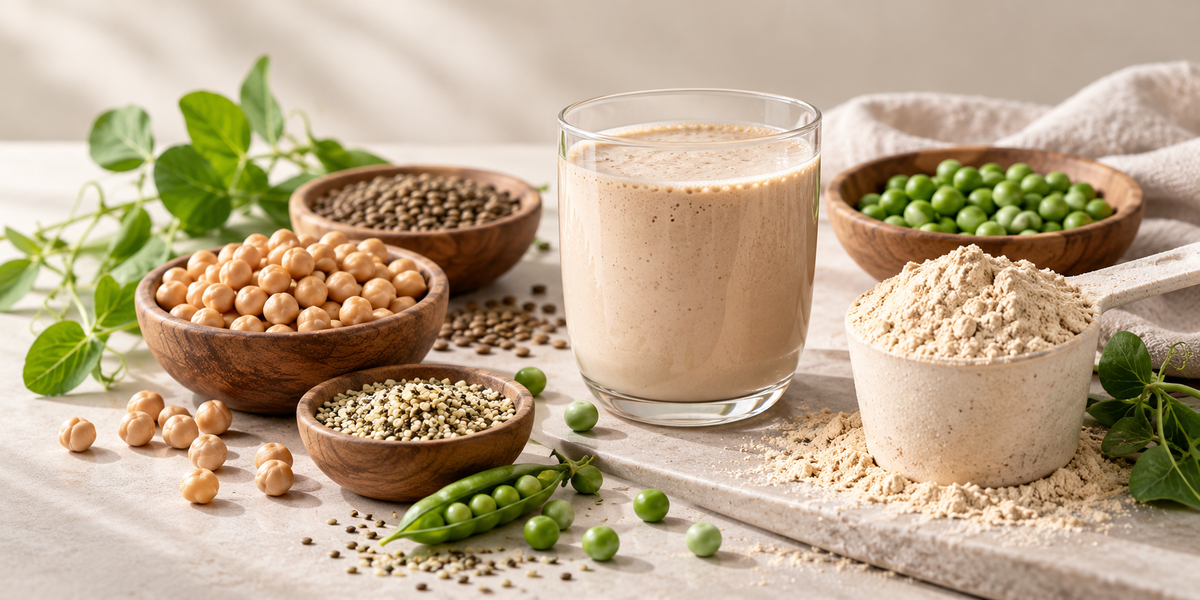
For example, an 80% pea protein isolate contains approximately 80 g of protein per 100 g of ingredient, making it possible to develop formulas with a high protein concentration.
This does not mean that a plant-based blend is an inferior option. In fact, combining high-quality isolates can provide an excellent nutritional profile. You simply need to pay attention to the protein concentration of the raw materials and how they are combined.
To choose the right plant-based protein, focus on the net amount of protein per serving, whether it has a complete amino acid profile and the origin of the protein source. Ultimately, when it comes to supporting your muscle mass, the quality of what you consume matters much more than the number of ingredients listed on the label.
Why Pea Protein Isolate (PURIS® Pea Protein) Is the Plant-Based Gold Standard
Its main advantage lies in its high protein concentration, essential amino acid content and nutritional versatility, characteristics that make it a suitable option for supplementing the diets of active individuals and athletes.
However, not all pea proteins are the same. The selection of raw materials and isolation processes directly influence the protein concentration and characteristics of the final ingredient.
In this context, PURIS® Pea Protein stands out as a pea protein isolate with an 80% protein content, selected by NDL Pro-Health for its Vegan Protein.
Complete Essential Amino Acid Profile and 24 g of Protein per Serving
Amino acids are the building blocks of proteins and participate in numerous processes in the body, including muscle protein synthesis.
Pea protein contains all nine essential amino acids, including branched-chain amino acids (BCAAs): leucine, isoleucine and valine, which are particularly relevant for muscle metabolism.
Among them, leucine stands out for its important role in activating mechanisms related to muscle protein synthesis.
NDL Vegan Protein provides 24 g of protein per serving, thanks to its formulation with PURIS® pea protein isolate.
Do Amino Acid Profiles Lie? The Importance of Purity in Sports Performance
To understand the quality of a protein, it is important to distinguish between the total amount of protein and the essential amino acids it provides.
Among the latter, branched-chain amino acids or BCAAs stand out, particularly leucine, which plays a role in activating muscle protein synthesis, a fundamental process for adaptation and recovery after exercise.
A protein may have a high total protein content while providing a different proportion of leucine or other essential amino acids.
Therefore, when comparing plant-based proteins, it is important to consider both the grams of protein per serving and their amino acid profile.
If you are looking for a plant-based protein that helps you meet your nutritional needs and achieve your sports goals, there are several aspects worth reviewing before making your choice:
- Protein per serving: check how many grams of protein each serving actually provides, not just the total weight of the product.
- Essential amino acid profile: pay attention to the presence and quantity of all nine essential amino acids, especially leucine.
- Protein concentration: identify whether the formula uses isolates or concentrates and what percentage of protein they contain.
- Raw material quality: consider the origin of the protein, its processing and the transparency of the nutritional information.
Ultimately, a good amino acid profile provides valuable information, but it does not tell the whole story.
Conclusion: How to Choose the Best Vegan Protein for Your Goals
The quality of the raw material, the essential amino acid profile and the protein concentration are fundamental factors when finding an option that suits your needs and accurately comparing high-quality proteins.
If your goal is to build muscle mass, improve post-workout recovery or maintain an adequate protein intake, it is important to choose a formula that provides a sufficient amount of protein and fits into a balanced diet.
Although plant-based protein blends can offer an adequate nutritional profile, a high-quality pea protein isolate allows you to obtain a high protein concentration from a single plant-based source, without the need to combine multiple ingredients.
For all these reasons, NDL Pro-Health chooses PURIS® Pea Protein, an 80% pea protein isolate, which provides all nine essential amino acids and 24 g of protein per serving.